April 2025
What 1,500 Founders Taught Me About Finding Product-Market Fit
After working with over 1,500 founders across every sector and stage imaginable, I have seen the product-market fit journey play out enough times to know what the patterns actually look like. Not the theory. Not the Twitter threads. The real, messy, uncomfortable patterns from the trenches.
Most of what gets written about PMF is either too abstract to be useful or too retrospective to be actionable. People describe it after the fact — “you will know it when you feel it” — which is about as helpful as telling someone they will know they are in love when it happens. True, but useless when you are in the middle of it.
Here are five patterns I have seen repeatedly. None of them are theoretical. All of them come from sitting across from founders in the thick of it and watching what actually happened.
Pattern 1: The 3x Customer Conversation Rule
The founders who find PMF fastest talk to customers at least three times more than those who do not. This is not a metaphor. It is a measurable, observable pattern.
I started tracking this informally a few years ago. When a founder finds PMF within their first year, I look back at what they did differently. The single most predictive behavior is the volume and depth of customer conversations. Not surveys. Not analytics dashboards. Not NPS scores. Actual conversations where they sat with a customer, asked open-ended questions, and listened.
The founders who struggle with PMF tend to build first and talk later. They spend months on the product and then try to find customers for it. The founders who find PMF fast do the opposite — they talk first and build what the conversations tell them to build.
One founder I coached was building a B2B scheduling tool. He had spent four months on features based on his own assumptions. I asked him how many potential customers he had interviewed. Seven. In four months. I told him to stop building and do thirty conversations in the next three weeks. What he learned in those conversations changed the entire product direction. The feature he thought was the core turned out to be irrelevant. A feature he had not even considered turned out to be the one thing people would pay for. He found PMF within two months of those conversations. The previous four months of building had been essentially wasted.
Talk to customers. Then talk to more customers. Then talk to more. This is the MVP stage in its truest form — not minimum viable product, but minimum viable proof that anyone cares.
Pattern 2: PMF Hides in Adjacent Markets
The first market you target is rarely the one that scales. This is one of the most counterintuitive patterns, and it trips up even experienced founders.
You start with a thesis about who your customer is. You build for that customer. And then something strange happens — a different customer shows up. Someone you did not expect. Someone from an adjacent market or a different use case or a different company size. And they love your product more than the people you built it for.
I have seen this happen so many times that I now tell founders to expect it. Slack was built as an internal tool for a gaming company. YouTube started as a dating site. Stewart Butterfield did not set out to build enterprise communication software. But the market told him something he was not expecting, and he was smart enough to listen.
The danger is when founders refuse to listen. They are so committed to their original thesis — “we are a tool for X market” — that they ignore the signal from adjacent markets where the pull is actually stronger. I worked with a founder last year who built a project management tool for creative agencies. Agencies liked it fine. But small e-commerce teams were obsessed with it. They were signing up faster, retaining better, and willing to pay more. The founder resisted the signal for months because it did not match the story in his pitch deck. By the time he pivoted, a competitor had already started serving that segment.
PMF is not always where you plant your flag. Sometimes it is two doors down. Your job is to notice.
Pattern 3: Premature Scaling Kills PMF
This is the pattern that breaks my heart the most, because it kills companies that had a real shot.
The story goes like this. You get early traction — a handful of paying customers, some encouraging metrics, a compelling narrative. You raise money. You hire. You invest in marketing. You scale the team, the infrastructure, the burn rate. And then you discover that the traction was not PMF. It was early adopters being generous. The product needed another iteration, another pivot, another round of customer discovery. But now you have a team of twenty, a burn rate of $200K a month, and investors expecting growth.
You cannot iterate your way to PMF when you are carrying the weight of a premature org. Every decision gets slower. Every pivot gets more expensive. Every month of searching costs ten times what it would have cost at a smaller scale.
The founders who navigate this well stay small until PMF is undeniable. Not until they have a few happy customers — until the demand is pulling them forward so hard that they have no choice but to scale. There is a massive difference between “we have some early customers and things look promising” and “we cannot keep up with demand and something has to change.” The first is a hypothesis. The second is PMF.
If you are not sure whether you have PMF, you do not have it. Keep the team small. Keep the burn low. Keep searching.
Pattern 4: Liking Is Not Buying
This one stings. But it is one of the most important distinctions a founder can learn.
“People love our product.” I hear this constantly. And I always ask the same follow-up: “How many of them are paying?” The silence that follows tells me everything.
There is a Grand Canyon-sized gap between “people like my product” and “people will pay for my product.” Liking is easy. It costs nothing. People will tell you your product is great because it is socially easier than telling you the truth. They will sign up for a free tier because there is no friction. They will give you positive feedback in a user interview because you are sitting right there and they do not want to be rude.
Buying is a completely different behavior. Buying requires someone to decide that your product is worth more than the money in their pocket. That decision involves trust, urgency, and a real problem that is painful enough to spend money solving. Plenty of products are likable without being buyable.
I coached a technical founder who had built a beautiful analytics tool. Gorgeous UI. Impressive demos. Everyone who saw it said great things. He had 3,000 free users. When he introduced a paid tier at $29 a month, eleven people converted. Eleven out of 3,000. That is not a pricing problem. That is a PMF problem. The product was admirable but not essential. People liked having it around but would not pay to keep it.
The cure is to charge early and often. Do not wait until the product is “ready” to ask for money. Charge from day one, even if the price is low. The willingness to pay is the most honest signal you will ever get. It cuts through every other form of validation noise.
Pattern 5: PMF Is a Panic, Not a Celebration
Here is the one that surprises everyone. The moment of product-market fit does not feel like success. It feels like a crisis.
When PMF actually hits, demand exceeds your ability to deliver. Customers are signing up faster than you can onboard them. Support tickets pile up. The infrastructure struggles. You need to hire but you cannot hire fast enough. Every system you built for ten customers breaks at a hundred. You are simultaneously thrilled and terrified.
I have watched this happen in real time with founders I coach. The call where they find PMF is never a celebration call. It is a “help me, everything is breaking” call. One founder told me, “I spent two years praying for customers and now I have too many and I don't know what to do.” That is PMF.
The next ninety days after PMF hits define whether you capture the moment or collapse under it. This is where founders need the most support, and ironically, it is when they are least likely to ask for it because they think success means they should have everything figured out.
If you are reading this and thinking “that sounds like my situation” — good problems to have, but they are still problems that need solving fast. The companies that win after finding PMF are the ones that scale their operations and team as aggressively as the market demands. The ones that collapse are the ones that try to maintain the same structure that got them to PMF. What got you here will not get you there.
What This Means for You
These five patterns are not a framework. They are observations from sitting in the room while it happens. Every founder's path to PMF is different in the details but remarkably similar in the structure.
If you are pre-PMF: talk to more customers, stay small, charge early, and watch for adjacent markets where the pull is stronger than expected. Do not scale until demand forces you to. Do not confuse liking with buying.
If you think you have PMF: stress-test it. Are people paying without heavy convincing? Is demand growing organically? Are you struggling to keep up? If the answer to all three is yes, you are probably there. Now the work shifts from finding PMF to capturing it.
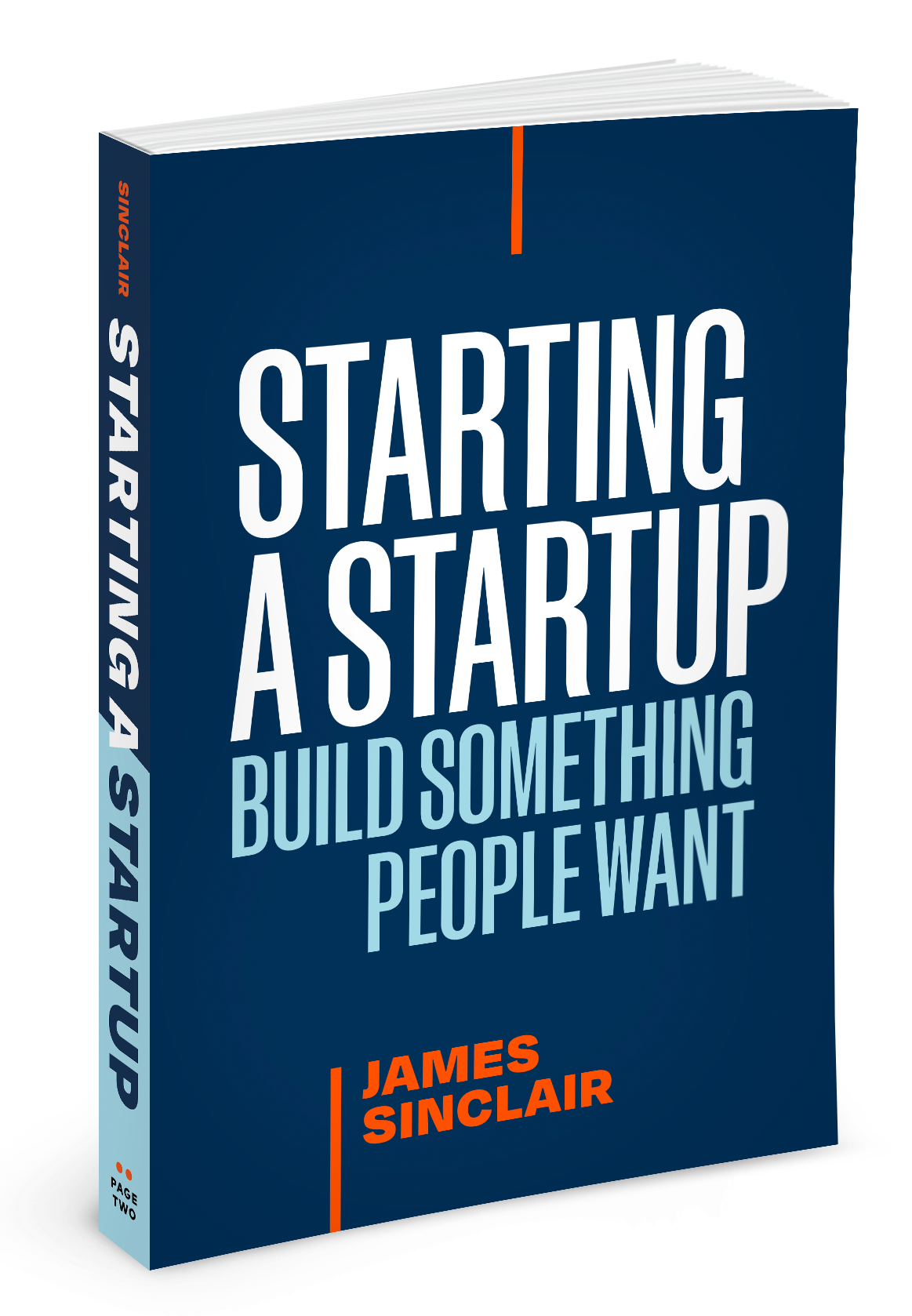
If you want to go deeper on this, my book covers the full journey from idea through scale. But the short version is this: PMF is not found by building more. It is found by listening harder. The founders who get there are not the best builders. They are the best listeners.
Searching for product-market fit? Let's pressure-test where you are.
Book an intro call with James